 blog
Affordable Orthodontic Treatment: Your 2026 Guide
Table of Contents
- Understanding Orthodontic Treatment Options and Their Costs
- Dental Insurance for Braces: Coverage and Benefits
- Orthodontic Payment Plans: Flexible Financing Options
- What to Ask at Your Braces Consultation
- Comparing Total Treatment Costs and Saving Money
- Finding Qualified Providers and Verifying Credentials
- Frequently Asked Questions
Last Updated: October 9, 2026
Understanding Orthodontic Treatment Options and Their Costs
Finding affordable orthodontic treatment in 2026 starts with understanding your options. Metal, ceramic, and clear aligners differ in benefits and cost; your choice depends on your dental needs, budget, and lifestyle.
Traditional Metal Braces
Traditional metal braces remain the most cost-effective option for most patients. They are durable, effective for complex cases, and typically fastest for severe misalignment.
Metal braces are especially suited for:
- Severe crowding or bite problems
- Patients who need faster results
- Those seeking the lowest upfront cost
The main drawback is visibility, but if cost is your priority, metal braces deliver reliable results without the premium price tag.
Ceramic Braces
Ceramic braces work like metal but use tooth-colored brackets, making treatment far less visible.
Ceramic braces offer a middle ground between affordability and appearance, costing more than metal but less than clear aligners. Their brackets are larger and need careful maintenance to avoid staining.
Best for:
- Adults who want discretion without high cost
- Patients with moderate alignment issues
- Those willing to pay slightly more for appearance
Clear Aligner Cost and Invisalign-Style Treatment
Clear aligners like Invisalign-style systems use custom plastic trays to shift teeth. They're nearly invisible and removable, but cost more than metal or ceramic braces.
Clear aligners work best for mild to moderate cases; complex bite problems often require traditional braces.
Clear aligners require discipline: wear them 20-22 hours daily. Skipping wear time extends treatment and increases cost through additional aligners.
Dental Insurance for Braces: Coverage and Benefits
Many dental insurance plans cover orthodontics, though coverage varies. Most cover 50% of treatment costs after your deductible, and some cap annual benefits.
Check your policy details:
- Does your plan cover orthodontics at all?
- What percentage does it cover (typically 50%)?
- Is there an annual maximum benefit?
Contact your insurer directly, or let the practice verify coverage before treatment, so you know what you'll pay versus what insurance covers.
Employer-sponsored plans often offer better orthodontic coverage than individual plans. If you're self-employed or between jobs, check whether a spouse's plan covers you.
Orthodontic Payment Plans: Flexible Financing Options
Most orthodontists know finding affordable orthodontic treatment matters to families. Payment plans break the total cost into manageable monthly installments.
In-House Financing and Down Payment Options
Many practices offer in-house plans: a down payment upfront, then monthly payments over the treatment period.
In-house plans often charge no interest if you pay on time, making them cheaper than credit-based financing. Ask about:
- Minimum down payment required
- Monthly payment amounts
- Whether payments change if treatment takes longer
Some practices waive or reduce down payments for financial hardship, so don't hesitate to discuss budget constraints at your consultation.
Third-Party Financing and Monthly Payment Plans
Third-party financing companies partner with dental practices on plans that work like medical credit cards: you're approved for a set amount and pay the financing company, not the practice.
Third-party plans may charge interest if you don't pay in full within a promotional period (often 12-24 months). Some offer zero-interest periods; others charge interest from day one.
Popular third-party financing options include:
- Medical credit cards designed for healthcare
- Personal installment loans through banks
- Dental-specific financing platforms
Compare options by total cost, not monthly payment, a lower monthly payment can mean more total interest.
What to Ask at Your Braces Consultation
Your consultation is your chance to understand treatment options, timelines, and costs.
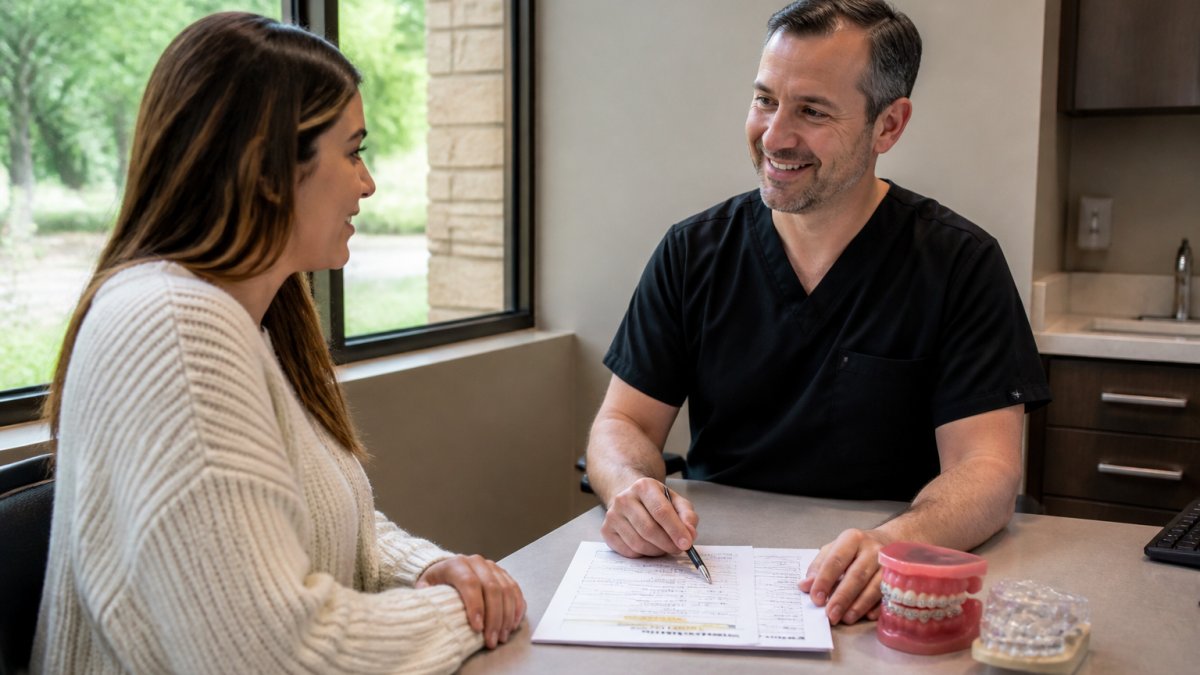
Essential questions to ask:
- What treatment option do you recommend for my specific case, and why?
- What's the total cost, and what does that include?
- How long will treatment take?
Write down the answers and compare multiple practices. Don't choose on price alone, the cheapest option isn't the best value if it means longer treatment or lower-quality care.
Comparing Total Treatment Costs and Saving Money
Most practices advertise a single monthly figure, but that rarely reflects what you pay from consultation to retainer. Compare providers using a written, line-item total cost for each quote, side by side.
Build a Line-Item Total Cost, Not a Monthly Payment
Ask every provider for a written quote broken into these categories. If a practice won't itemize, treat that as a red flag.
- Consultation and diagnostic records, initial exam, panoramic and cephalometric X-rays, intraoral scans or impressions, and photographs. Some practices bundle these; others charge separately, often in the low hundreds of dollars.
- Active treatment, the braces hardware or aligner trays themselves, plus all scheduled adjustment visits for the quoted treatment period.
- Retainers, almost always a separate line. Most patients need both a removable retainer and, in many cases, a bonded fixed retainer. Retainer replacement after loss or breakage is usually billed again.
Add every line across all quotes: a lower monthly payment can still cost more once retainers, refinements, and emergency visits are added.
A Quote Comparison Checklist
Use the same checklist for every provider:
- Total treatment fee, in writing, with an expiration date.
- What is included versus billed separately (records, retainers, refinements, emergency visits, retention check-ins).
- Estimated treatment length in months, and what happens to the fee if treatment runs longer.
- Down payment required and number of monthly installments.
- Whether the quoted monthly payment is interest-free, and if not, the total finance charge.
- Insurance estimate applied to the quote, and who verifies benefits.
- Refund or transfer policy if you move, change providers, or stop treatment.
- Whether the quote changes if you switch treatment types mid-course.
Where the Real Savings Come From
Once you have true totals, the biggest levers are:
- Treatment type, metal braces generally carry the lowest total fee, ceramic brackets sit in the middle, and clear aligners are typically highest. Choosing based on clinical suitability, not just price, avoids paying twice for a treatment that cannot correct your case.
- Insurance timing, if your plan has a calendar-year maximum, starting treatment so that records and the bulk of active treatment fall in one benefit year, or splitting across two, can change your out-of-pocket total. Confirm the specifics with your plan before scheduling.
- In-network versus out-of-network, in-network providers have negotiated fees and usually bill insurance directly. Out-of-network providers may charge more but sometimes offer steeper in-house discounts. Compare the net total, not the sticker fee.
Treatment Duration and Complexity
Treatment length directly affects total cost. Simple cases finish in roughly 12 to 18 months; complex cases run two to three years or longer, meaning more adjustment visits and cost.
Ask for a realistic written timeline, and be cautious of providers promising unusually fast results, rushing tooth movement can damage roots or create bite problems needing later treatment.
Finding Qualified Providers and Verifying Credentials
Cost matters, but the cheapest quote is only a bargain if the provider is qualified and treatment is properly supervised. A few verification steps protect both your teeth and your money.
Verify the Credentials That Actually Matter
- Specialty training, An orthodontist completes dental school plus an accredited orthodontic residency, typically two to three years of additional training. A general dentist can legally offer braces or aligners in many states without that residency, so ask directly whether the treating provider is an orthodontic specialist.
- Board certification, The American Board of Orthodontics certifies orthodontists who pass a written exam and a case-based clinical examination. You can verify certification status through the ABO's public directory.
- State licensure, Confirm an active license through your state dental board's online lookup. Licensure status and any disciplinary actions are usually public.
Confirm Who Is Actually Supervising Your Treatment
This is the question low-cost and direct-to-consumer aligner services rarely answer clearly. Ask:
- Who reviews my scans and X-rays, and are they an orthodontist?
- Who designs my treatment plan, and how often is it reviewed?
- Who do I contact if a tooth stops tracking or an aligner does not fit?
A common pattern with remote aligner services is that treatment is planned by an orthodontist you never meet, with monitoring through photos or scans you submit. That model can work for straightforward cases, but complex bite problems, severe crowding, and extraction cases usually require in-person evaluation. If no one can tell you who is supervising your case, that is your answer.
Check Reviews and Ask for Referrals
- Read reviews with a filter, Look for patterns rather than single complaints. Repeated mentions of billing surprises, missed appointments, or difficulty reaching the office after treatment starts are meaningful signals.
- Ask your general dentist, Your dentist sees the finished results of local orthodontists and can tell you who communicates well and who does not.
- Ask about the retention phase, A provider who plans for retainers and long-term retention from day one is usually thinking past the active treatment period.
Public, Nonprofit, and Employer-Based Options
If cost is the main barrier, these paths are frequently overlooked:
- Dental schools, Accredited dental and orthodontic programs often provide treatment at reduced fees under faculty supervision. Treatment can take longer because appointments are scheduled around the academic calendar, but the savings can be substantial.
- Community health centers, Federally qualified health centers and community clinics may offer orthodontic services on a sliding-fee scale based on income. Availability varies widely by location.
- Medicaid and state programs, Coverage for orthodontics varies by state and is often limited to children with a documented medical need, such as a severe bite problem. Check your state Medicaid program's specific orthodontic criteria.
A Shortlist Before You Commit
Before signing anything, confirm you have: a written itemized quote, a named treating provider with verifiable credentials, a clear answer on who supervises your care, a written treatment timeline, and a refund or transfer policy.
At EPO Dental Specialists, we understand that finding affordable orthodontic treatment requires both quality care and transparent pricing. Our Board-Certified orthodontist works with your personal dentist to ensure coordinated, high-quality treatment.
American Board of Orthodontics certification verification
Frequently Asked Questions
What factors affect the cost of orthodontic treatment?
Several factors influence affordability and total cost. Treatment complexity determines duration and resource intensity. Tooth misalignment severity, jaw positioning issues, and whether extractions are needed all affect pricing. Your chosen treatment type, metal braces, ceramic braces, or clear aligners, carries different costs. Geographic location, provider experience level, and practice overhead also play roles. Treatment duration typically ranges from 18 to 36 months depending on your case. Insurance coverage and available financing options further impact your out-of-pocket expense. Request a detailed treatment plan during your consultation to understand which factors apply to your specific situation.
Does dental insurance cover braces or clear aligners?
Many dental insurance plans offer orthodontic coverage, though benefits vary significantly. Typical orthodontic coverage ranges from 50% of treatment costs, though some plans cover less or more. Most plans include a lifetime maximum benefit, often between $1,000 and $2,000. Many require a waiting period before orthodontic benefits activate, typically 6 to 12 months. Age limits apply to some plans; children may have better coverage than adults. Coverage for clear aligners like Invisalign is less common than metal braces coverage, though this is changing. Review your specific plan documents or contact your insurance provider to confirm what orthodontic services are covered, what your deductible is, and whether pre-authorization is required before starting treatment.
What should I ask an orthodontist before starting treatment?
Ask about the total treatment cost, monthly payment amount, and what that price includes. Request an itemized treatment plan showing each phase and expected duration. Clarify what happens if treatment takes longer than estimated and whether additional costs apply. Ask about financing options, down payment requirements, and whether they offer in-house payment plans. Inquire about their experience with your specific case type and ask for before-and-after examples. Request information about retainers, whether they're included in the price and what happens if you need replacements. Ask about emergency care procedures and how often you'll need appointments. Finally, ask how they handle insurance claims and whether they can provide an estimate of your insurance benefits before you commit.
Can I use an HSA or FSA to pay for orthodontic treatment?
Yes, orthodontic treatment qualifies as a medical expense under both Health Savings Accounts (HSAs) and Flexible Spending Accounts (FSAs). You can use pre-tax dollars from these accounts to pay for braces, clear aligners, and related orthodontic care. This effectively reduces your out-of-pocket cost by lowering your taxable income. With an HSA, unused funds roll over year to year, giving you flexibility to spread payments across multiple years if treatment extends beyond one calendar year. FSA funds must typically be used within the plan year, though some plans offer a grace period. Check with your plan administrator about their specific rules and any documentation requirements. Using these accounts can make affordable orthodontic treatment even more accessible by reducing costs through tax advantages.
Finding affordable orthodontic treatment in 2026 is possible when you understand your options and ask the right questions. The key is comparing total costs across multiple providers, exploring payment plans and insurance coverage, and choosing a qualified orthodontist who listens to your budget concerns. At EPO Dental Specialists, we're committed to making quality orthodontic care accessible. Request an appointment today to discuss your treatment options and find a plan that works for you.