
 listicle
Benefits of Multi-Specialty Dentistry
Table of Contents
- What Multi-Specialty Dentistry Offers
- Multi-Specialty vs General Dentistry: Key Differences
- How Coordinated Dental Treatment Plans Work
- The Importance of Dental Specialist Collaboration
- Continuity of Care and Long-Term Outcomes
- Addressing Dental Anxiety in a Specialty Practice
- Efficiency and Convenience of One-Stop Specialty Care
- Frequently Asked Questions
Last Updated: September 20, 2026
What Multi-Specialty Dentistry Offers
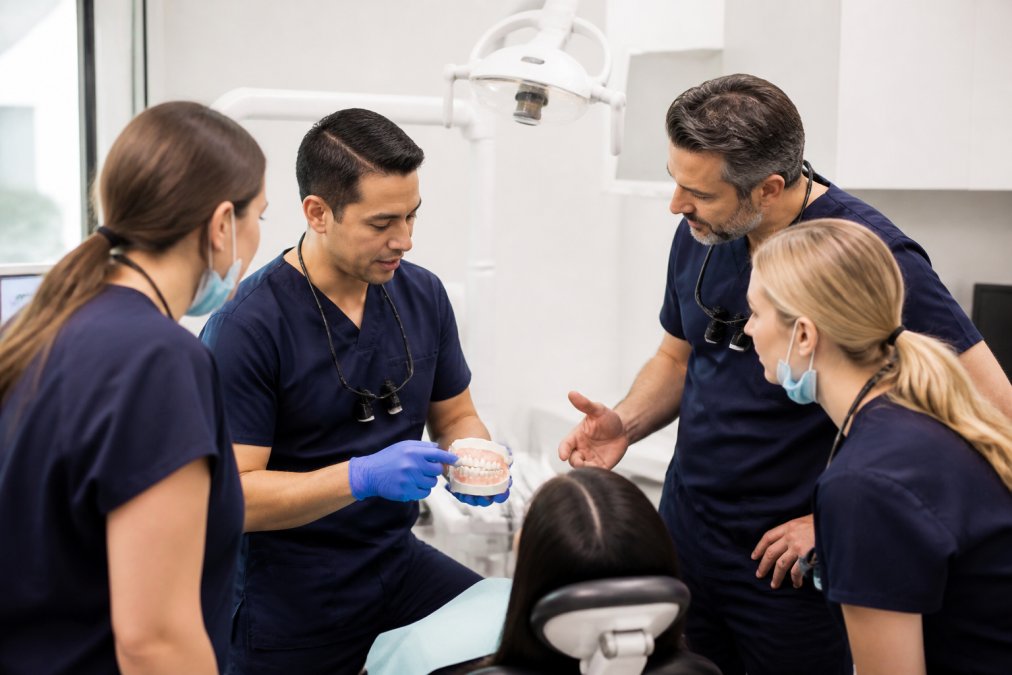
Multi-specialty dentistry is an integrated approach to dental care where multiple specialists work under one roof to address complex oral health needs. Rather than visiting separate practices for endodontics, periodontics, orthodontics, or oral surgery, patients receive coordinated care from a team of experts in a single location.
This model differs fundamentally from traditional referral-based dentistry. Instead of your general dentist sending you to three different specialists across town, a multi-specialty practice houses endodontists, periodontists, orthodontists, and other specialists on the same team. They share patient records, imaging, and treatment planning in real time.
At EPO Dental Specialists, this integrated structure means your complex cases, whether involving gum disease, root canals, or orthodontic alignment, are handled by specialists who communicate directly with each other and your referring dentist.
Multi-Specialty vs General Dentistry: Key Differences
General dentists excel at preventative care, cleanings, fillings, and routine restorations. They're your first line of defense for oral health. But when a case requires specialized training, severe periodontal disease, complex root canal anatomy, surgical extractions, or comprehensive orthodontic correction, general dentists typically refer you elsewhere.
The difference becomes clear when you need multiple treatments. With general dentistry alone, you might visit your primary dentist, then drive to an endodontist across town, then to an orthodontist in another suburb. Each specialist works in isolation, ordering their own imaging and making independent treatment decisions.
Multi-specialty dentistry eliminates this fragmentation. Specialists collaborate on your case from the start. They review the same cone beam scans, discuss treatment sequencing together, and adjust plans based on real-time input from colleagues. This coordination prevents conflicting treatment approaches and reduces the total time your care takes.
A key advantage emerges when your case involves multiple disciplines. Suppose you need gum grafting, a root canal, and orthodontic movement to close a gap. In a traditional model, the periodontist completes the graft, the endodontist handles the root canal months later, and the orthodontist starts after both are done. In a multi-specialty practice, all three specialists review your case upfront, sequence treatments strategically, and coordinate timing so one procedure supports the next.
How Coordinated Dental Treatment Plans Work
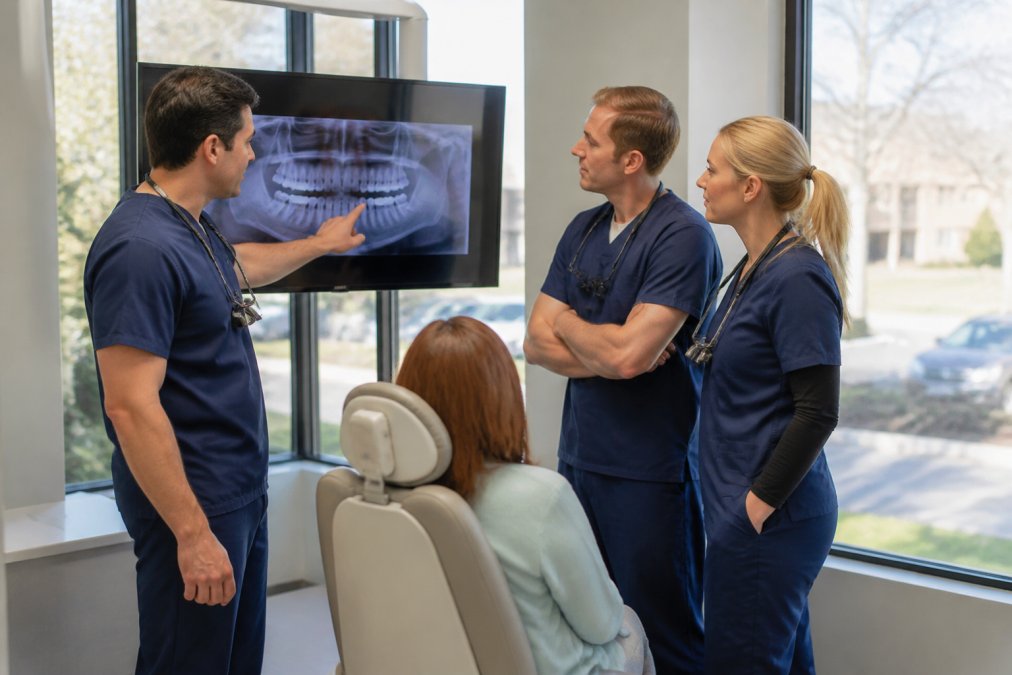
A coordinated dental treatment plan begins with a comprehensive oral evaluation where all relevant specialists examine you, review your imaging, and discuss findings together, not sequentially over weeks or months. But the depth of coordination depends heavily on the diagnostic technology available and how specialists integrate that data.
Shared Diagnostic Imaging and Real-Time Collaboration
Multi-specialty practices invest in high-end diagnostic equipment that all specialists access from one system. Cone beam computed tomography (CBCT) scanners, for example, provide three-dimensional imaging of bone structure, tooth roots, and anatomical landmarks. In a traditional referral model, your general dentist might order a CBCT, but when you're referred to an endodontist, that specialist orders their own scan, duplicating radiation exposure and cost. In a multi-specialty practice, one CBCT scan serves all specialists. The endodontist reviews it for root canal anatomy, the periodontist assesses bone levels for grafting, and the orthodontist evaluates bone density for implant planning. All three work from identical data, eliminating conflicting interpretations.
Intraoral scanners, digital cameras that capture tooth surfaces and bite relationships, are another example. These tools create precise three-dimensional models used for treatment planning. When all specialists access the same scan data, they can overlay their treatment plans on the same digital model. The orthodontist can visualize exactly where the periodontist plans to place an implant, and adjust tooth movement to create ideal spacing and angulation. The endodontist can confirm that planned orthodontic forces won't compromise a root canal. This level of coordination is impossible when specialists work from separate scans in separate offices.
Integrated Treatment Planning Software
Many multi-specialty practices use integrated practice management and clinical documentation systems that allow specialists to annotate the same patient record in real time. When the periodontist completes a bone graft assessment, they document findings and recommendations in a shared note that the orthodontist and endodontist see immediately. If the endodontist discovers an unexpected anatomical variation during a root canal, they can update the record and notify other team members instantly, rather than waiting for a referral letter to arrive weeks later.
This shared documentation also ensures treatment sequencing is explicit and agreed upon. Rather than each specialist making independent decisions, the team documents the planned sequence, for example: "Periodontal therapy weeks 1-4, root canal week 6, orthodontic movement begins week 8", and all specialists commit to that timeline. If circumstances change, the entire team adjusts the plan together.
Comprehensive Assessment Identifies the Full Scope
This collaborative assessment identifies the full scope of your needs in ways a single specialist cannot. Rather than one specialist seeing only their piece of the puzzle, the entire team understands your complete clinical picture. An orthodontist evaluating a patient in isolation might recommend tooth movement that would fail if the patient has undiagnosed periodontal disease. A periodontist might recommend bone grafting without knowing that an endodontist has already compromised that tooth's viability. A multi-specialty team reviews all factors upfront and develops a plan that accounts for the entire clinical reality.
They then develop a single integrated plan that sequences treatments logically. Some treatments must happen before others. For example, if you need periodontal therapy and a root canal, the gum disease treatment often comes first to reduce infection risk and improve healing capacity. An orthodontist might delay tooth movement until bone levels stabilize after grafting. A multi-specialty team plans this sequence upfront, preventing costly delays or treatment failures later.
Communication Between Specialists Happens Continuously
Communication between specialists happens continuously throughout treatment, not just at the planning stage. If the endodontist discovers an unexpected anatomical variation during your root canal, the periodontist and orthodontist are notified immediately. If your gum health improves faster than predicted, the timeline adjusts accordingly. If the orthodontist observes that bone is resorbing faster than expected, the periodontist modifies the graft site or recommends a different implant approach. This real-time collaboration keeps your treatment on track and allows the team to capitalize on positive developments or pivot quickly if complications arise.
In contrast, patients receiving care from separate specialists often experience treatment delays because one specialist completes their work, then the next specialist discovers a problem that requires the first specialist to retreat the area. By the time the issue is resolved, months have passed. A coordinated team catches these problems before they occur.
The Importance of Dental Specialist Collaboration
Dental specialists bring deep expertise in narrow domains. An endodontist spends years mastering root canal anatomy and microsurgical techniques. A periodontist specializes in complex bone grafting and implant placement. An orthodontist understands three-dimensional tooth movement and occlusal relationships. When these experts collaborate, outcomes improve.
Collaboration prevents clinical errors that occur when specialists work in isolation. Consider a patient needing both periodontal surgery and orthodontic movement. Without coordination, the orthodontist might apply forces that compromise the surgical graft site. With collaboration, the periodontist communicates exactly where and when movement is safe, and the orthodontist adjusts force vectors accordingly. (Source: National Institute of Dental and Craniofacial Research (NIDCR) on oral health statistics)
The importance of dental specialist collaboration extends to treatment efficiency. When specialists discuss your case before treatment begins, they identify the most effective sequence and eliminate redundant procedures. This saves time, reduces your total number of appointments, and often improves outcomes because treatments build on each other strategically.
Research and clinical experience show that integrated treatment planning produces better long-term results than sequential specialist referrals. Patients experience fewer complications, faster healing, and more stable outcomes when specialists coordinate from the beginning.
Continuity of Care and Long-Term Outcomes
Continuity of care means your treatment doesn't fragment across different providers. One team maintains your complete record, tracks your progress, and adjusts plans based on how you respond over time.
This matters most for complex cases. If you're undergoing gum grafting, root canal therapy, and orthodontic correction, continuity ensures each specialist knows exactly what the others accomplished and plans accordingly. Years later, if a problem emerges, your specialists have detailed records of every procedure and can make informed decisions about retreatment.
Long-term outcomes improve when one team monitors your case over months and years. The periodontist watches how bone levels respond to grafting. The endodontist checks that your root canal remains stable. The orthodontist confirms that tooth positions remain stable after active treatment. This ongoing oversight catches problems early and prevents expensive complications.
Patients also benefit from consistent communication.
Addressing Dental Anxiety in a Specialty Practice
Dental anxiety affects roughly one in five adults, making necessary treatment feel impossible. Multi-specialty practices address this through several mechanisms.
Efficiency and Convenience of One-Stop Specialty Care
The convenience of one-stop-shop dentistry extends far beyond reducing drive time. While visiting one location instead of three saves time, the real efficiency gain lies in streamlined billing and insurance coordination.
Consolidated Billing and Insurance Processing
Reduced Administrative Burden
Real-Time Treatment Cost Visibility
Efficiency in Clinical Outcomes
Frequently Asked Questions
What is the difference between a general dentist and a multi-specialty practice?
A general dentist handles routine cleanings, fillings, and basic care for most patients. A multi-specialty practice brings together specialists in areas like endodontics (root canals), periodontics (gum disease), and orthodontics (braces and alignment). Specialists complete additional training and certification in their fields, allowing them to handle complex cases that general dentists may refer out. Multi-specialty dentistry means you can access expert care for complicated conditions without multiple referrals.
How does integrated care benefit patients with complex dental needs?
When multiple specialists work together on your case, they share patient records, coordinate treatment timing, and align their approaches. This reduces complications, prevents conflicting treatment plans, and shortens overall care time. For example, if you need gum disease treatment before implant placement, specialists can sequence your care efficiently. Integrated care also improves outcomes because each specialist understands the full picture of your oral health rather than treating one issue in isolation.
Can a multi-specialty dental office handle emergency care?
Yes. Multi-specialty practices often have specialists on-site and advanced diagnostic equipment like cone beam scanners, which means emergency cases like severe tooth pain or complex fractures can be evaluated and treated immediately. You don't have to wait for a referral or travel to another office. Having endodontists and oral surgeons available means serious emergencies receive expert care right away, reducing pain and preventing complications.
Is it more cost-effective to visit a multi-specialty dental office?
Multi-specialty practices can reduce overall costs by eliminating multiple referrals, coordinating treatment to avoid redundant procedures, and completing care more efficiently. You also avoid paying separate consultation fees at different offices. However, pricing depends on the complexity of your case and your insurance coverage. Contact your specialist office directly to discuss your specific treatment plan and costs.