
 how-to
How to Find Reputable Endodontists: A Step-by-Step Guide
Table of Contents
- Understanding the Difference: Endodontist vs General Dentist for Root Canal
- Step 1: Verify Board Certification and Professional Credentials
- Step 2: Use the AAE Find My Endodontist Tool and Dental Directories
- Step 3: Review Patient Testimonials and Online Reviews
- Step 4: Evaluate Clinical Experience and Advanced Technology
- Step 5: Ask Critical Questions During Your Consultation
- Red Flags to Avoid When Selecting an Endodontist
- Insurance, Payment Options, and Post-Procedure Expectations
- Frequently Asked Questions
Last Updated: October 2, 2026
Understanding the Difference: Endodontist vs General Dentist for Root Canal
An endodontist is a dental specialist who focuses on treating diseases and injuries of the tooth's pulp and root, and knowing how to find reputable endodontists ensures you receive expert care. They complete two to three years of specialized training beyond dental school to become experts in root canal therapy and complex endodontic procedures, while general dentists handle routine cleanings and fillings (Find a Program).
Endodontists handle complex cases using microscopes, digital imaging, and specialized techniques that general dentists typically lack.
Your general dentist will refer you to an endodontist if your tooth pain is severe, the anatomy is complex, or previous treatment failed.
At EPO Dental Specialists, we work closely with referring dentists and use state-of-the-art technology to handle everything from root canal therapy to surgical endodontics.
Step 1: Verify Board Certification and Professional Credentials
A board-certified endodontist has passed rigorous exams and maintains ongoing education. Look for "Diplomate of the American Board of Endodontics" (ABOE). Verify credentials through the American Dental Association (ADA) website or your state dental board.
Ask directly: "Are you board-certified by the American Board of Endodontics?" Credentials should be displayed in the office or easily accessible online.
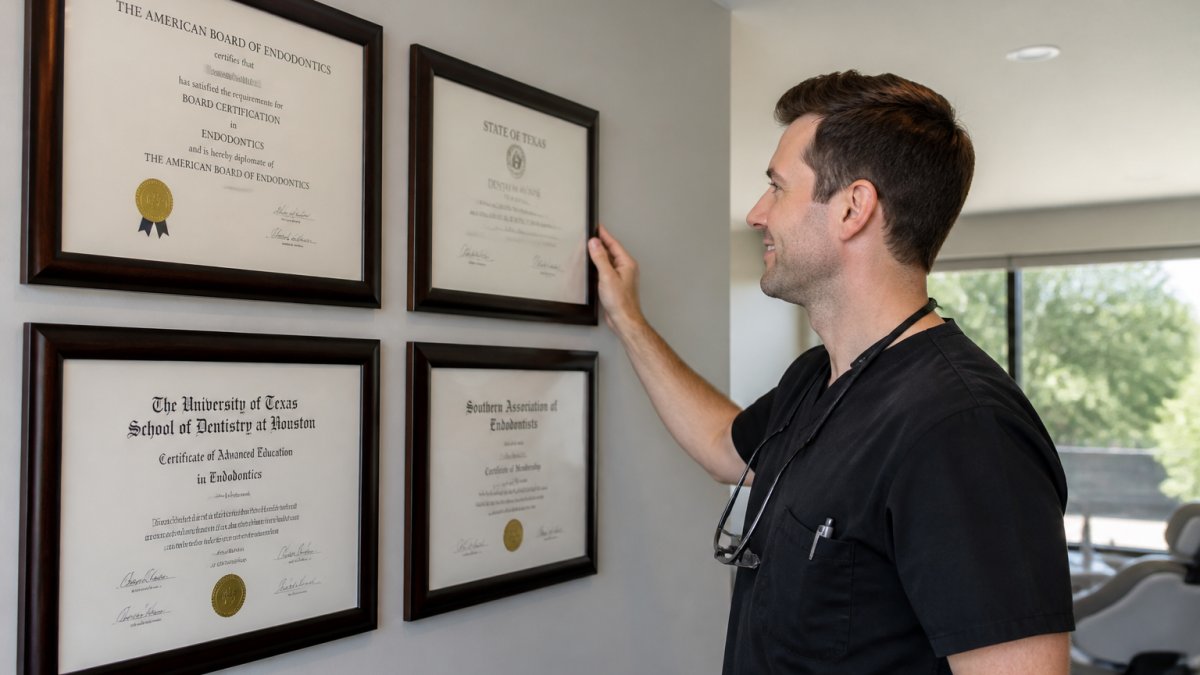
Look for these credentials:
- DDS or DMD degree from an accredited dental school
- Completed endodontic residency program
- Board certification from ABOE or state equivalent
- Active membership in the American Association of Endodontists (AAE)
- Current state dental license
Step 2: Use the AAE Find My Endodontist Tool and Dental Directories
Use the AAE "Find My Endodontist" tool to find board-certified specialists in your area. Cross-reference with Zocdoc, Healthgrades, and your state dental board. Endodontists appearing across multiple directories typically have stronger reputations.
Use these resources to build your initial list:
- AAE Find My Endodontist directory
- State dental board website (verify licenses)
- Healthgrades or Zocdoc (patient reviews and ratings)
- Your general dentist's referral list
- Insurance provider's directory
Step 3: Review Patient Testimonials and Online Reviews
Read reviews on Google, Healthgrades, and Zocdoc, looking for patterns. Multiple mentions of pain management, comfort, or rushed appointments are telling. Negative reviews often reveal how the endodontist handles complications.
Look for specific details: Did the endodontist explain the procedure clearly? Was pain management effective? Were follow-up appointments handled properly? Detailed feedback is more useful than generic praise.
Watch for red flags: repeated mentions of infection after treatment, staff rudeness, or pressure to accept unnecessary procedures. Multiple similar complaints suggest a real problem.
Step 4: Evaluate Clinical Experience and Advanced Technology
Ask how many root canals they perform monthly and whether they've handled re-treatment or surgical cases. Ask what equipment they use: CBCT scanners, operating microscopes, and digital imaging systems improve outcomes by revealing tooth anatomy and complications before treatment.
Step 5: Ask Critical Questions During Your Consultation
Come prepared with questions. Ask "What does my tooth need?" and listen for a clear explanation of why root canal therapy is necessary and what happens if you don't treat it.
Ask about the procedure (duration, appointments, pain management, success rate, risks), patient comfort (anxiety management, sedation options, step-by-step explanation), and follow-up care (checkup timing, post-treatment monitoring, communication with your general dentist).
When you find reputable endodontists, they answer questions directly, don't pressure you to decide immediately, and respect your concerns about cost, pain, and time commitment.
Red Flags to Avoid When Selecting an Endodontist
Certain warning signs suggest you should look elsewhere. Understanding the difference between normal practice variation and genuine red flags will help you make a confident decision.
Clinical Red Flags
Refusal to take diagnostic imaging before treatment is a serious concern.
Unwillingness to discuss treatment alternatives is problematic. A good endodontist explains why they recommend root canal therapy over alternatives like extraction.
Pressure to extract a tooth when root canal therapy is viable is a financial red flag.
Inability to explain sterilization and infection control protocols is serious. Ask how they sterilize instruments.
Refusal to explain the procedure or dismissing your questions suggests they don't respect informed consent.
Financial Red Flags
Unusually low pricing compared to other board-certified endodontists in your region might indicate corners are being cut.
Demand for full payment upfront without a detailed treatment plan is concerning. Reputable practices explain what they'll do and discuss payment options before you commit.
Unwillingness to work with your dental insurance or discuss coverage beforehand suggests they may not be transparent about costs. A good practice will verify benefits and discuss out-of-pocket responsibility before treatment.
Communication and Coordination Red Flags
Refusal to communicate with your general dentist is a significant red flag. Your general dentist needs to know the outcome to provide appropriate follow-up care and restoration.
Staff that seems rushed, dismissive, or unwilling to answer questions reflects the practice's culture.
Vague or evasive answers about credentials or experience should concern you. If they avoid the question or seem defensive when asked about board certification, that's a red flag.
Specific Warning Signs in Reviews
Watch for patterns of infection or treatment failure in reviews. Multiple mentions of infection after treatment or lack of explanation suggest a real problem.
Complaints about lack of follow-up after complications are important. If reviews say the endodontist was unavailable or dismissive after complications arose, that's a serious concern.
Red flags to watch for:
- Diagnostic imaging refused or skipped
- Unwillingness to discuss alternatives to root canal therapy
- Pressure to extract a tooth without exploring endodontic options
- Inability to explain sterilization and infection control protocols
- Demand for full payment before a detailed treatment plan
- Refusal to communicate with your general dentist
- Vague or evasive answers about board certification or experience
- Multiple patient reviews mentioning infection or treatment failure
- Staff that seems rushed or impatient
- Dismissal of your anxiety or concerns about the procedure
Insurance, Payment Options, and Post-Procedure Expectations
Understanding Insurance Coverage
Insurance coverage for root canal therapy varies significantly by plan.
Call your insurance company before your appointment to confirm:
- What percentage of the cost they'll cover
- Whether there's a deductible you need to meet first
- Whether the endodontist is in-network or out-of-network
- Whether pre-authorization is required
- Whether surgical endodontics is covered (if relevant to your case)
In-Network vs. Out-of-Network Considerations
Choosing an in-network endodontist typically means lower out-of-pocket costs.
If you choose an out-of-network endodontist, ask the office to submit a claim to your insurance on your behalf.
Don't let insurance status alone determine your choice.
Payment Options and Financial Planning
Ask about payment options during your initial consultation.
After root canal therapy, your tooth will need a permanent restoration, usually a crown, placed by your general dentist.
What to Expect Immediately After Treatment
Your tooth will be numb for 2 to 4 hours after treatment.
Mild to moderate soreness is normal for 3 to 5 days after treatment.
Avoid hard, sticky, or crunchy foods for at least one week.
Your tooth may feel slightly different or "high" when you bite down.
Post-Procedure Follow-Up and Healing Expectations
Healing takes weeks to months as bone around the tooth's root gradually fills in.
Watch for these signs of normal healing:
- Decreasing soreness over the first week
- No swelling or only mild swelling that resolves within a few days
- Ability to chew normally on other teeth
- No sensitivity to temperature after the first week
When to Contact Your Endodontist About Complications
Certain symptoms after treatment warrant immediate contact with your endodontist:
Severe pain that doesn't improve with medication after the first few days suggests a problem. Contact your endodontist if pain worsens after day 3.
Swelling of the face, jaw, or gums that appears or worsens after treatment may indicate infection. Call your endodontist immediately.
Fever after endodontic treatment can indicate infection. If you develop a fever above 101°F, contact your endodontist.
How Reputable Endodontists Handle Complications
Complications happen even with excellent care.
If you develop a problem after treatment, contact your endodontist first. If they're unavailable or dismissive, that's a red flag.
Getting Your Permanent Restoration
Don't delay getting a permanent restoration from your general dentist.
Long-Term Success and Maintenance
Most teeth treated with root canal therapy remain functional for many years.
Maintain good oral hygiene by brushing twice daily, flossing daily, and seeing your general dentist for regular checkups.
Your endodontist may take follow-up X-rays at 1 year and 5 years to confirm the tooth remains healthy.
Frequently Asked Questions
What credentials should I look for in an endodontist?
Look for board certification from the American Board of Endodontics (ABE), which requires advanced training beyond dental school and passage of rigorous clinical exams. Verify credentials through the ADA's Find a Dentist tool or the AAE website. A reputable endodontist should have a Doctor of Dental Surgery (DDS) or Doctor of Medicine in Dentistry (DMD) degree, plus specialized post-graduate training in endodontics. Ask about their experience with complex cases and whether they maintain continuing education in root canal therapy and surgical endodontics.
How do I know if an endodontist is good?
A good endodontist demonstrates clinical experience, maintains high treatment success rates, uses advanced technology like cone beam imaging and operating microscopes, and prioritizes patient-centered care. Review patient testimonials on trusted platforms and ask about their approach to pain management and post-operative care. Check if they're affiliated with dental associations and whether they accept your insurance. During consultation, observe if they take time explaining your treatment plan and answer your questions thoroughly without rushing.
Is it better to have a root canal done by a dentist or endodontist?
Endodontists are dental specialists with two to three additional years of advanced training specifically in root canal therapy and related procedures. For routine root canals, a general dentist may be capable, but for complex cases, curved roots, or surgical endodontics like apicoectomy, an endodontist's specialized expertise and advanced technology typically yield better clinical outcomes. Many general dentists refer complex cases to endodontists for this reason. Your dentist's referral often indicates the case's complexity and the need for specialist-level care.
Do endodontists accept dental insurance?
Most endodontists accept dental insurance, but coverage varies by plan and specific procedure. Contact the specialist's office directly with your insurance information to verify in-network status and understand your out-of-pocket costs. Some endodontists offer payment plans for uninsured patients or those with high deductibles. Ask about pre-authorization requirements and whether the office can file claims on your behalf. Understanding your coverage before treatment prevents billing surprises and helps you plan financially.