 how-to
Why Your Jaw Clicks When You Chew Food
Table of Contents
- Why Your Jaw Clicks When You Chew Food
- Common Causes of Jaw Clicking and Popping
- Understanding Temporomandibular Disorder Symptoms
- How to Stop Jaw Clicking: Practical Self-Care Strategies
- Bruxism and Jaw Pain: The Grinding Connection
- TMJ Treatment Options and When to Seek Care
- Frequently Asked Questions
Last Updated: October 18, 2026
Why Your Jaw Clicks When You Chew Food
Jaw clicking is one of the most common complaints we hear at EPO Dental Specialists.
The good news: most jaw clicks when chewing are harmless.
Your jaw joint is complex: moving parts, muscles, and a cushioning disc that work together.
Here are the most common causes of jaw clicking when chewing, what's happening inside your joint, and practical steps to reduce the clicking and discomfort.
Common Causes of Jaw Clicking and Popping
Jaw clicking happens for several reasons. Most of them are manageable on your own. A few warrant professional evaluation.
Disc Displacement and Joint Movement
Inside your TMJ sits a small cartilage disc. This disc cushions the joint and helps it move smoothly.
The disc can slip slightly out of position; when your jaw moves, it catches and pops back into place, that's the clicking sound.
Early disc displacement usually doesn't hurt, you just hear the click.
A dentist or specialist can determine whether your disc displacement needs treatment or if conservative care is enough.
Muscle Tension and Overuse
Your jaw muscles work constantly. Chewing tough foods, clenching, or holding facial tension tightens them, and tight muscles pull on the jaw joint, changing how smoothly it moves.
When muscles are tense, the joint doesn't glide properly, producing clicking or popping during chewing, usually with muscle soreness or stiffness in the jaw area.
The fix is straightforward: relax the muscles. Warm compresses, gentle stretching, and reducing tension help, and most people improve within days.
Teeth Grinding and Clenching
Bruxism, grinding or clenching your teeth, puts enormous pressure on your jaw joint. Many people clench without realizing it, especially during stress or sleep.
Constant clenching wears down the joint surfaces and stresses the disc. The joint responds by clicking or popping.
Addressing the grinding stops the clicking from getting worse. We'll cover this more in depth below.
Understanding Temporomandibular Disorder Symptoms
Temporomandibular disorder (TMD) is when the TMJ isn't functioning properly. Jaw clicking is often an early sign, but not everyone with clicking has TMD.
TMD symptoms include:
- Clicking, popping, or grinding sounds in the jaw
- Jaw pain or tenderness
- Difficulty opening your mouth fully
- Locking of the jaw (it gets stuck open or closed)
Clicking alone with no other symptoms likely isn't TMD. But if clicking comes with pain, limited movement, or headaches, it's worth getting evaluated.
The key distinction: clicking by itself is usually harmless; clicking plus pain or dysfunction is TMD and benefits from professional care.
How to Stop Jaw Clicking: Practical Self-Care Strategies
Most painless jaw clicking improves with conservative care, but order and consistency matter more than any single remedy. The plan below runs from least to most effortful, built on one principle: reduce load on the temporomandibular joint long enough for irritated tissue to settle, then gradually return to normal use.
Step 1: Take the load off for 7 to 10 days
Start with temporary food changes. For roughly a week to ten days, choose soft foods cut into small pieces: eggs, yogurt, cooked vegetables, soft fish, pasta, and smoothies.
Pair this with jaw rest: keep your teeth slightly apart at rest, tongue lightly behind your upper front teeth. This neutral resting jaw posture reduces the low-grade clenching most people do without noticing.
Step 2: Use heat and cold correctly
Heat and cold do different jobs; using the wrong one at the wrong time can slow relief.
- Heat relaxes tight muscles and improves blood flow. Apply a warm, not hot, compress to the side of your face for about 15 minutes, up to three times a day. A warm shower or a heated rice bag wrapped in a towel works. Never apply heat to an area that is swollen, hot to the touch, or recently injured.
- Cold reduces inflammation and numbs sore spots. Use an ice pack wrapped in a thin cloth for 10 to 15 minutes at a time, especially after a flare-up or after a long chewing session. Do not put ice directly on the skin.
A common pattern is heat before gentle stretching and cold after activity or at the end of the day.
Step 3: Gentle movement, not aggressive stretching
Once soreness eases, add gentle range-of-motion work: open slowly to a comfortable width, never to the point of pain, hold about 5 seconds, and repeat 5 to 10 times, two or three times a day.
Stop any exercise that causes sharp pain, locking, or a new click that hurts. More aggressive stretching, forcing your mouth open, or "popping" the joint on purpose tends to make symptoms worse, not better.
Step 4: Calm the muscles
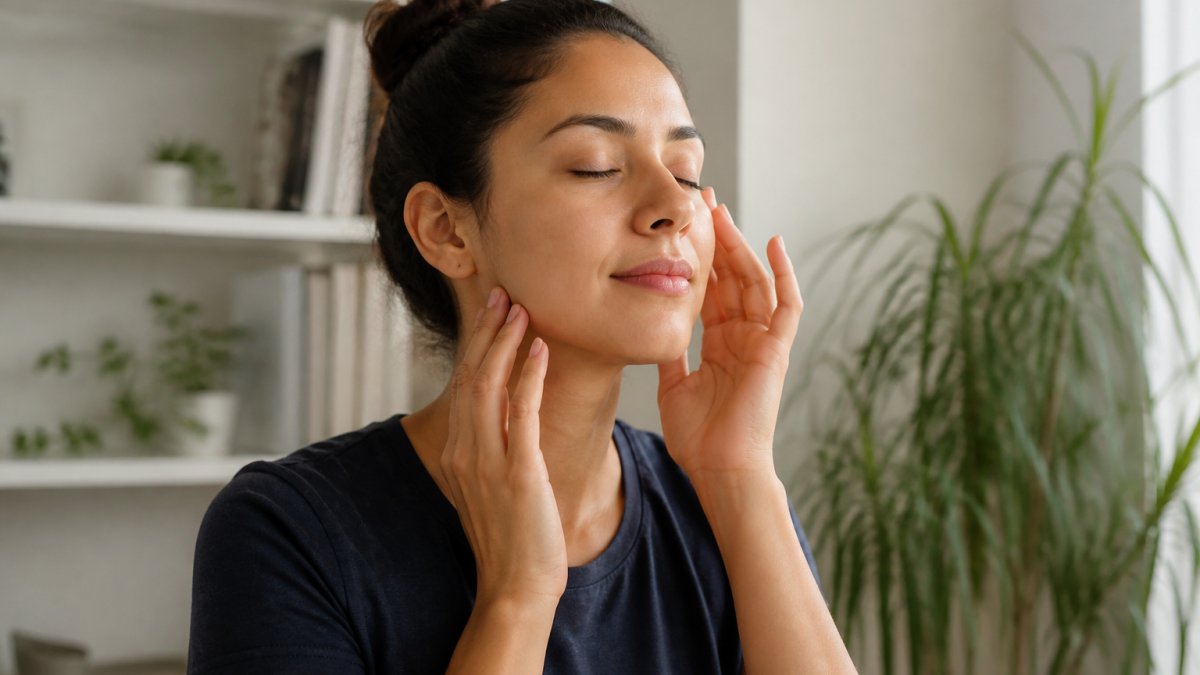
Massage the muscles at the side of your face (the masseter) and at the temples (the temporalis) with small, slow fingertip circles for a minute or two at a time.
Stress reduction is part of muscle care: clenching is a stress response, so brief daily relaxation, slow breathing, a short walk, or 10 minutes of quiet, reduces the clenching that drives clicking.
Step 5: Address habits that reload the joint
Once acute soreness fades, address the habits that caused the problem. Stop chewing gum and avoid chewing on pens, fingernails, or ice. If you grind or clench at night, ask your dentist about a custom night guard, a well-fitted guard cushions the teeth and reduces clenching force, though it doesn't cure the habit.
What not to do
- Do not force your jaw open or try to "fix" the click by popping it.
- Do not chew gum as a substitute for jaw exercise.
- Do not rely on heat on a swollen or injured jaw.
- Do not ignore new pain, locking, or swelling in the hope that it will pass.
How long it takes and when to escalate
Most people notice improvement within 1 to 2 weeks of consistent care. If clicking persists beyond about three weeks despite these steps, or comes with pain, locking, swelling, or limited opening, schedule an evaluation.
Bruxism and Jaw Pain: The Grinding Connection
If you grind or clench your teeth, your jaw clicking likely stems from that habit. Bruxism creates constant pressure on the TMJ.
Grinding often happens at night without you knowing. Signs include:
- Worn, flattened teeth
- Jaw soreness upon waking
- Headaches in the morning
- Damage to dental work
During the day, catch yourself clenching. If your teeth are touching, relax your jaw. Let your teeth part slightly.
Addressing bruxism is one of the most effective ways to stop jaw clicking. Without treating the grinding, the clicking usually returns even after other interventions.
TMJ Treatment Options and When to Seek Care
Self-care resolves most painless clicking, but the decision to seek care should rest on specific red flags, not the sound alone. Here's when to get help, how a clinician determines the cause, what the evidence supports, and what to be cautious about.
When clicking needs professional evaluation
Seek an evaluation if any of the following apply:
- Clicking persists for more than about three weeks despite consistent self-care.
- Clicking comes with jaw pain, headaches, ear pain, or pain when chewing.
- You cannot open your mouth fully, or opening is visibly limited or asymmetric.
- Your jaw locks, catches, or gets stuck open or closed.
How clinicians figure out the cause
Clicking alone does not establish a diagnosis of temporomandibular disorder (TMD) (TMD). Many people with clicking have no disorder at all. A clinician starts with history and examination:
- History: when the clicking started, whether it hurts, what makes it worse (chewing, yawning, morning clenching), whether there is locking, and whether there was an injury or recent dental work.
- Examination: measuring how wide you can open, feeling the joint and jaw muscles for tenderness, listening for the click, and checking your bite and tooth wear.
- Imaging: plain X-rays or a cone-beam CT may be used to look at the bony joint, and MRI can show the disc and soft tissues. Imaging is generally reserved for cases with pain, locking, trauma, or a suspected structural problem, not for a painless click that is stable.
This stepwise approach matters because treatment depends on the cause: a muscle-dominant, disc, dental, or injury-related problem is managed differently, and treating the wrong one wastes time and money.
Treatment options and what the evidence supports
Conservative, reversible care is the first line for nearly all jaw clicking and TMD symptoms:
- Physical therapy: a therapist teaches jaw exercises, posture correction, and manual techniques to improve movement and reduce muscle tension. This is among the best-supported conservative options.
- Dental evaluation and a custom appliance: if grinding or clenching is contributing, a dentist-fitted night guard cushions the teeth and reduces clenching force. It manages the habit; it does not cure it.
- Bite evaluation: if your bite is uneven, a dentist can assess whether adjustment is appropriate. Bite adjustment is irreversible, so it should follow a careful diagnosis, not be a first reflex.
- Medication: short-term anti-inflammatories or muscle relaxants can ease a flare-up, but they treat symptoms, not the underlying cause.
- Referral: complex or persistent cases may benefit from evaluation by an oral and maxillofacial surgeon, orthodontist, or pain specialist.
What to be cautious about
Be wary of irreversible or unsupported treatments offered without a clear diagnosis, aggressive bite reshaping, full-mouth reconstruction sold as a TMD cure, or anything promising to "cure" clicking permanently. Surgery is rarely appropriate for jaw clicking alone. Ask what the diagnosis is, what the evidence is, and whether a conservative option was tried first.
What to expect over time
Most people improve with conservative care over weeks, not days. Keep a simple symptom log to track progress and give your clinician useful information:
- Date and time of clicking episodes
- Whether there was pain, and how severe (0 to 10)
- What triggered it (chewing, yawning, morning)
- Any locking, limited opening, or swelling
- What you did and whether it helped
Bring the log to your appointment: it helps distinguish a stable, harmless click from a progressing problem and makes follow-up more efficient.
At EPO Dental Specialists, our team evaluates jaw function and symptoms to identify the cause before recommending treatment. We favor conservative, reversible care first and coordinate with your general dentist on bite and grinding issues.
Frequently Asked Questions
Why does my jaw click when I chew food?
Jaw clicking during chewing typically occurs when the disc inside your temporomandibular joint moves out of position or when muscles surrounding the jaw joint become tense. Stress, teeth grinding, chewing gum, hard foods, and repetitive chewing habits can trigger this clicking sound. While harmless clicking is often just a sign of joint movement, persistent clicking accompanied by pain or limited jaw movement may indicate temporomandibular disorder and warrants a professional evaluation.
Is jaw clicking during eating something I should worry about?
Not all jaw clicking requires immediate concern. Occasional clicking without pain or difficulty chewing is usually harmless. However, seek professional evaluation if your clicking is accompanied by jaw pain, difficulty opening your mouth, jaw locking, limited jaw movement, or if the clicking occurs frequently. A dental specialist can determine whether your clicking reflects normal joint function or a developing temporomandibular disorder that needs treatment.
Can stress and teeth grinding cause jaw clicking?
Yes. Stress causes muscles in your jaw and neck to tighten, increasing joint strain. Bruxism (teeth grinding and clenching) intensifies this muscle tension and puts additional stress on your temporomandibular joint and the cartilage disc inside it. Over time, this repetitive stress can lead to disc displacement, causing the clicking or popping sound you hear when chewing. Managing stress through relaxation techniques and addressing grinding habits can help reduce jaw clicking.
What are the main TMJ treatment options?
Treatment depends on the underlying cause and severity. Conservative approaches include rest, ice or heat therapy, jaw exercises, stress management, and avoiding hard or chewy foods. A night guard can protect your teeth if you grind or clench. For persistent symptoms, physical therapy, anti-inflammatory medication, or dental bite correction may help. In rare cases, advanced treatment such as joint injections or surgery is considered. A specialist will recommend the right approach based on your specific condition.