
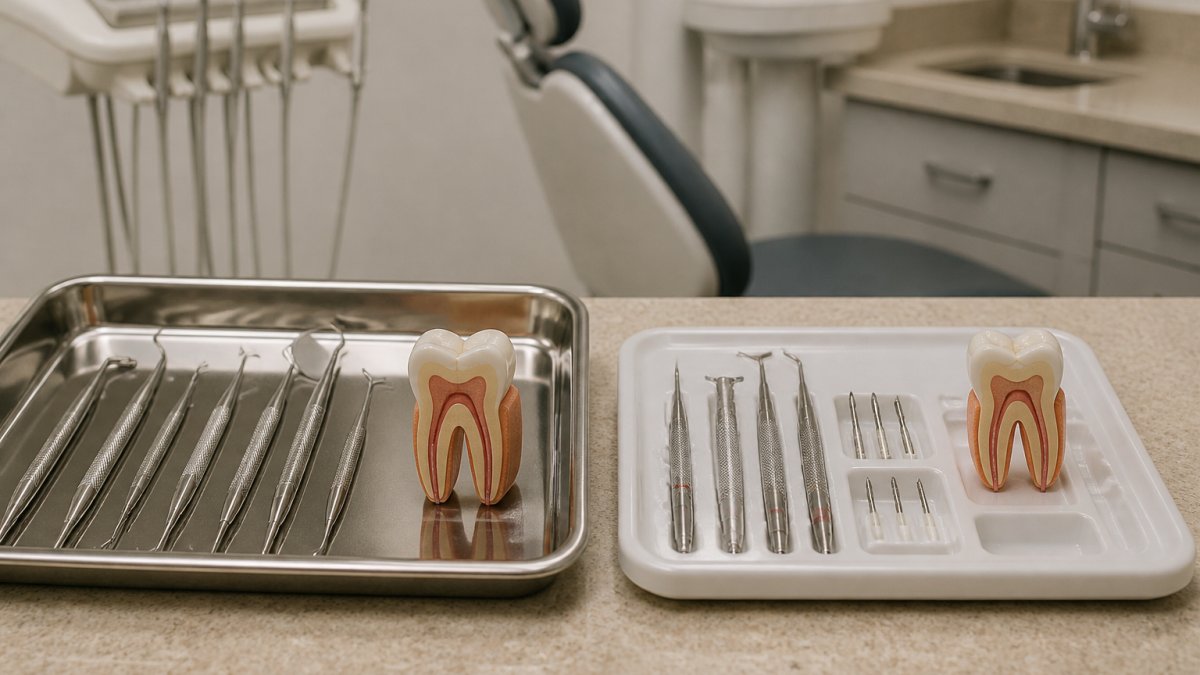
 comparison
Endodontist vs General Dentist for Root Canal Care
Table of Contents
- Endodontist vs General Dentist for Root Canal: Key Differences
- Comparison Table: Endodontist vs General Dentist
- When to See an Endodontist for Root Canal Treatment
- Root Canal Procedure Duration: What to Expect
- Root Canal Retreatment: Why a Second Visit May Be Needed
- Root Canal Referral Questions to Ask Your Provider
- Cost, Insurance, and What Happens After Referral
- Frequently Asked Questions
Last Updated: October 15, 2026
Endodontist vs General Dentist for Root Canal: Key Differences
An endodontist is a dentist who completed two or more years of advanced training after dental school and limits their practice to treating the inside of teeth. According to the American Association of Endodontists, endodontists are the dental professionals who focus exclusively on saving natural teeth through root canal treatment and related procedures.
At EPO Dental Specialists, patients across Richardson, Plano, and the greater DFW Metroplex ask this constantly. Most assume a root canal is a root canal, no matter who performs it, true for straightforward cases, false for complicated ones.
Below: the training, experience, and case-by-case factors that should drive your decision, plus questions worth asking before you commit.

Training and Education: Residency vs Dental School
Every licensed dentist completes dental school and can legally perform root canal treatment. The difference is what happens after.
An endodontist completes two or more additional years of residency focused entirely on the dental pulp, root canal systems, and surrounding tissues, covering tooth pain diagnosis, infection management, and advanced techniques for locating and cleaning canals.
A general dentist learns root canal therapy as one part of a broad curriculum covering fillings, crowns, extractions, gum care, and more. The American Dental Association maintains resources on dental specialties and what each type of specialist is trained to do.
Procedure Volume and Root Canal Experience
Volume matters more than most patients realize: a provider performing root canals weekly develops a feel for canal anatomy that someone doing a few per year does not.
Root canal systems are not simple tubes. Many teeth have curved, extra, or branching canals that standard X-rays may not fully reveal, and unusual anatomy demands a provider who has seen that variation before.
Experience compounds.
Comparison Table: Endodontist vs General Dentist
| Factor | Endodontist | General Dentist |
|---|---|---|
| Post-dental-school training | 2+ years residency in endodontics | None required |
| Scope of practice | Root canal treatment and related surgery only | Full general dentistry |
| Typical case type | Complex, retreatment, unusual anatomy | Straightforward, single-canal cases |
| Technology | Dental operating microscope, 3D imaging | Varies by practice |
| Cost | Often higher for the same procedure | Often lower |
| Best for | Complicated cases, retreatment, diagnostic uncertainty | Routine cases with clear anatomy |
When to See an Endodontist for Root Canal Treatment
See an endodontist when your case involves complex anatomy, a previous failed root canal, or diagnostic uncertainty about which tooth is causing pain. For a routine single-root canal on a straightforward tooth, your general dentist is often the right, more affordable choice.
The decision usually comes down to case complexity, not provider prestige. Here is a practical, case-by-case way to think about it.
A Practical Decision Guide by Case Type
Use these examples as a starting point, not a rule, any provider can refer you if the case proves more involved than expected.
Often well-suited to a general dentist:
- A front tooth or premolar with a single, straight, clearly visible canal
- A first-time root canal on a tooth with no prior treatment and no signs of spreading infection
- A case where the diagnosis is clear from standard X-rays and the tooth is not tender to bite
Worth a specialist evaluation:
- A molar with three or four canals, especially if any canal is curved or the roots are close together
- A tooth with a calcified or narrowed canal, common in older teeth or after trauma
- Any retreatment of a tooth that has already had a root canal
A general dentist who performs root canals regularly can handle many of the first group well. The second group is where magnification, 3D imaging, and focused case volume matter most.
What Success-Rate Claims Actually Measure
Success rates are often quoted as if one number settles the endodontist-versus-general-dentist question. It does not, and it is worth understanding why.
Success-rate studies typically measure whether a tooth is still present and free of detectable infection after several years.
A few practical implications:
- A high success rate reported for a specialist practice may reflect that the practice sees complex cases, the very cases where a specialist's tools and experience matter most. It does not automatically mean a general dentist would have failed the same tooth.
- A success rate reported for general dentists may include many straightforward cases that would have succeeded with almost any competent provider.
- A single comparison number rarely applies to your specific tooth. The relevant question is not "which provider type has the higher rate" but "which provider is best equipped for the anatomy and history of this tooth."
Most practitioners find the biggest driver of a good outcome is complete cleaning and sealing of the canal system, followed by a timely, well-fitted restoration.
Complex Cases and Root Canal Retreatment
Complex cases include teeth with multiple curved canals, calcified canals narrowed over time, roots needing retreatment, and infection spread beyond the root tip. These call for magnification, 3D imaging, and canal-finding experience from focused practice.
Root canal retreatment deserves special attention. When a first root canal fails, the cause is often a missed canal, an incomplete seal, or new infection.
Urgent Symptoms and Timing of Care
Severe tooth pain, swelling around a tooth, a bad taste near a treated tooth, or pain that wakes you at night all point to a pulp infection needing prompt attention. These symptoms do not resolve on their own, and delay can turn a saveable tooth into an extraction.
Seek prompt dental or emergency evaluation if you notice:
- Facial or jaw swelling, especially if it is firm or spreading
- Fever alongside tooth pain or swelling
- Difficulty swallowing or breathing, or swelling that pushes on your eye or neck
Those signs can indicate an infection moving beyond the tooth, a medical situation, not just a dental one. Call a provider who can see you quickly.
Root Canal Procedure Duration: What to Expect
A root canal procedure duration typically runs 30 to 90 minutes, depending on the tooth and case complexity.
Most straightforward cases finish in one visit. Complex cases, active infections, or retreatments may require two appointments to complete cleaning, shaping, and sealing properly.
Anesthesia keeps the procedure comfortable. Modern pain management means most patients report the experience is easier than they expected, often easier than the toothache that brought them in.
Root Canal Retreatment: Why a Second Visit May Be Needed
Retreatment is more involved than a first root canal: the provider must remove existing filling material, re-clean the canal system, and often address anatomy the original treatment did not fully reach.
If your general dentist recommends retreatment, ask whether they will perform it or refer you. There is no shame in either answer. A provider who refers is being honest about where their strengths lie.
Root Canal Referral Questions to Ask Your Provider
Ask these questions before committing to a provider for a root canal referral. They will tell you more about your care than any website.
- How many root canals do you perform in a typical month?
- Will you use magnification, such as a dental operating microscope, for my case?
- Do you take 3D imaging, or only standard digital X-rays?
Cost, Insurance, and What Happens After Referral
Cost is where the endodontist-versus-general-dentist decision gets real, and where most guides stop short: they compare the provider fee for the root canal itself and ignore everything around it. The number that matters is your total out-of-pocket cost for saving the tooth, consultation, imaging, the root canal, any retreatment, and the final restoration.
What Drives the Total Cost of a Root Canal
Several variables move the total, and they interact:
- Tooth type. Molars have more canals and take longer than front teeth, so they cost more to treat regardless of provider.
- First treatment versus retreatment. Retreatment means removing existing filling material and re-cleaning the canal system, which adds time and complexity.
- Provider type. A specialist's fee for the same procedure is often higher than a general dentist's, reflecting the additional residency, magnification, and case volume. That premium is not automatically worth it for a straightforward single-canal tooth, and it often is for a curved molar or a failed prior treatment.
A useful way to frame it: the root canal is the middle of the cost story, not the end. Ask for a written estimate listing the root canal, the buildup if needed, and the crown as separate lines so you see the whole picture before you commit.
Insurance Scenarios to Expect
Dental plans vary widely, but a few patterns are common enough to plan around:
- Many plans cover a percentage of root canal therapy after a deductible, then cover a percentage of the crown under a separate category, sometimes at a different rate.
- Some plans require preauthorization for specialist treatment or for retreatment. Submitting a pre-treatment estimate before the appointment avoids surprises.
- Annual maximums can be exhausted by a root canal plus a crown in the same plan year. If you are close to your maximum, ask whether splitting treatment across two plan years is an option.
Call your insurer with the procedure codes your provider gives you, and ask the office to submit a pre-treatment estimate. That single step resolves most cost anxiety before treatment starts.
Before, During, and After a Referral
If your general dentist refers you to an endodontist, here is how the handoff typically works so nothing falls through the cracks:
Before the referral. Your general dentist diagnoses the problem, takes X-rays, and decides the case is beyond routine, then sends your records, imaging, and a note about the tooth to the endodontist. Ask whether the endodontist will take their own imaging or rely on what was sent, this affects both time and cost.
During the specialist phase. The endodontist performs the root canal, then sends a report back to your general dentist describing what was found and done.
After the root canal. Your general dentist typically places the final restoration, the crown or filling, within a few weeks, once the tooth has settled.
Follow-up. Ask who is responsible for the post-treatment check.
Before you agree to treatment, get three things in writing: the total estimated cost including the final restoration, who performs each phase, and who handles follow-up. A provider who can answer all three clearly is coordinating your care, not just selling a procedure.
The American Association of Endodontists' patient resources offers guidance on what to expect during and after root canal treatment.
Frequently Asked Questions
Is an endodontist better than a general dentist for a root canal?
It depends on the case. Endodontists complete two or more years of advanced training beyond dental school and focus almost entirely on root canal treatment, so they bring more experience with complex anatomy, infections, and retreatment. General dentists are fully qualified to perform straightforward root canals and often do so successfully. For uncomplicated cases, either provider can deliver good results. For curved canals, calcified teeth, or a second root canal, an endodontist's specialized training often makes a meaningful difference.
When should I see an endodontist instead of a general dentist?
Your general dentist may refer you when the tooth has unusual anatomy, a previous root canal has failed, or the infection is severe. Other signs include persistent tooth pain after treatment, an abscess that does not resolve, or a need for retreatment. If you have severe tooth pain, swelling, or a dental abscess, seek care promptly. An endodontist has the magnification, 3D imaging, and procedure volume to handle these complex cases. Ask your dentist whether a referral is appropriate for your situation.
Can a general dentist perform a root canal?
Yes. General dentists are trained to perform root canal treatment during dental school and can handle many straightforward cases in their office. They routinely treat front teeth and less complicated molars. However, if the tooth has multiple curved canals, a history of failed treatment, or significant infection, your dentist may recommend an endodontist. A referral is not a sign your dentist lacks skill; it is a decision to match the complexity of the case to the right provider.
How long does a root canal procedure take?
A straightforward root canal on a front tooth often takes 30 to 60 minutes. Molars with multiple canals can take 90 minutes or longer, and retreatment or complex cases may require two visits. The duration depends on the number of canals, the presence of infection, and whether the tooth needs a new crown. Your provider will give you an estimate after reviewing your dental imaging and diagnosis.
Does insurance cover a root canal performed by an endodontist?
Most dental insurance plans cover medically necessary root canal treatment regardless of whether a general dentist or endodontist performs it. Coverage percentages vary by plan, and some plans may require preauthorization or a referral. Because an endodontist's fee is often higher than a general dentist's, your out-of-pocket cost may differ. Check your specific plan's benefits and ask the office for a cost estimate before scheduling.