 how-to
7 Ways Collaboration Improves Long-Term Oral Health Outcomes
Last Updated: October 29, 2026
Quick Summary
Improving long-term oral health outcomes depends less on any single procedure and more on whether your dentist, specialist, and medical doctor share information through coordinated care. A closed-loop referral workflow, naming the clinical question, sending records securely, booking the appointment before the patient leaves, and returning a written report, keeps every case owned at every stage.
- A North Carolina teledentistry initiative raised visits from 402 to 2,953, a 635% jump.
- The same program saw self-management goals climb 285%.
- Book the specialist appointment before the patient walks out to protect referral completion.
- Assign a referral coordinator, clinical lead, and specialist liaison clear accountability roles.
- Track referral completion rate, time to appointment, report turnaround, and follow-up completion monthly.
Table of Contents
- Why Coordinated Care Beats Isolated Visits for Long-Term Oral Health Outcomes
- General Dentist vs Specialist: Who Handles What
- The Dentist Specialist Referral: When and Why It Happens
- What Good Dental Care Coordination Looks Like in Practice
- The Referral Workflow: A Step-by-Step Path From General Dentist to Specialist
- Where Collaboration Breaks Down: Urgent Referrals, Delays, and Failed Handoffs
- How Interdisciplinary Care Teams Improve Patient Outcomes
- Requesting a Specialist Appointment at EPO Dental Specialists
- Frequently Asked Questions
Why Coordinated Care Beats Isolated Visits for Long-Term Oral Health Outcomes
A North Carolina oral-health initiative pushed teledentistry visits from 402 to 2,953, a 635% jump reported by the Foundation for Health Leadership & Innovation's 2025 report. The same program saw self-management goals climb 285%. Neither result came from a single brilliant dentist. Both came from providers talking to each other.
That is the case for collaboration in one paragraph. Improving long-term oral health outcomes depends less on any one procedure and more on whether your dentist, specialist, and medical doctor share information.
Below, we break down how collaboration can change results, plus a referral workflow that supports it.
General Dentist vs Specialist: Who Handles What
A general dentist manages your overall oral health: exams, cleanings, fillings, and preventive care. A dental specialist completes advanced training in one area and handles complex cases.
The split matters because each provider sees a different slice of your health.
- General dentist: routine care, early detection, your dental home
- Endodontist: root canal therapy and complex tooth pain
- Periodontist: gum disease and implant placement
- Orthodontist: tooth alignment and bite correction
Your general dentist is the quarterback. Specialists handle the plays that need a deeper skill set. Knowing the roles helps prevent duplicate work. If you are still unsure about specialist roles, our complete guide to what a dental specialist is explains each one.
The Dentist Specialist Referral: When and Why It Happens
A dentist specialist referral is a formal handoff from your general dentist to a provider with advanced training in one area. It happens when a case exceeds what routine care can safely resolve.
Common triggers include:
- A root canal on a curved or previously treated tooth
- Gum disease that needs surgical management
- A tooth that cannot be saved and needs extraction planning
- Orthodontic work that affects bite and jaw function
Referrals are not a sign your dentist gave up. They are a sign the case got the right attention. Research on interdisciplinary strategies for older adults shows collaboration among dentists, physicians, nurses, and nutritionists is now an active focus, precisely because complex cases rarely sit in one silo.
What Good Dental Care Coordination Looks Like in Practice
Dental care coordination means every provider on your case works from the same information. In practice, it looks like this:
- Your specialist receives your chart before your first visit
- Your medical history and medication list travel with the referral
- Your general dentist gets a written report after treatment
- Someone owns the follow-up
That last point is where most practices fall short. A referral without a closing report is an open loop. Nobody knows whether you actually went, what was found, or what happens next.
Good coordination closes that loop every time.
The Referral Workflow: A Step-by-Step Path From General Dentist to Specialist
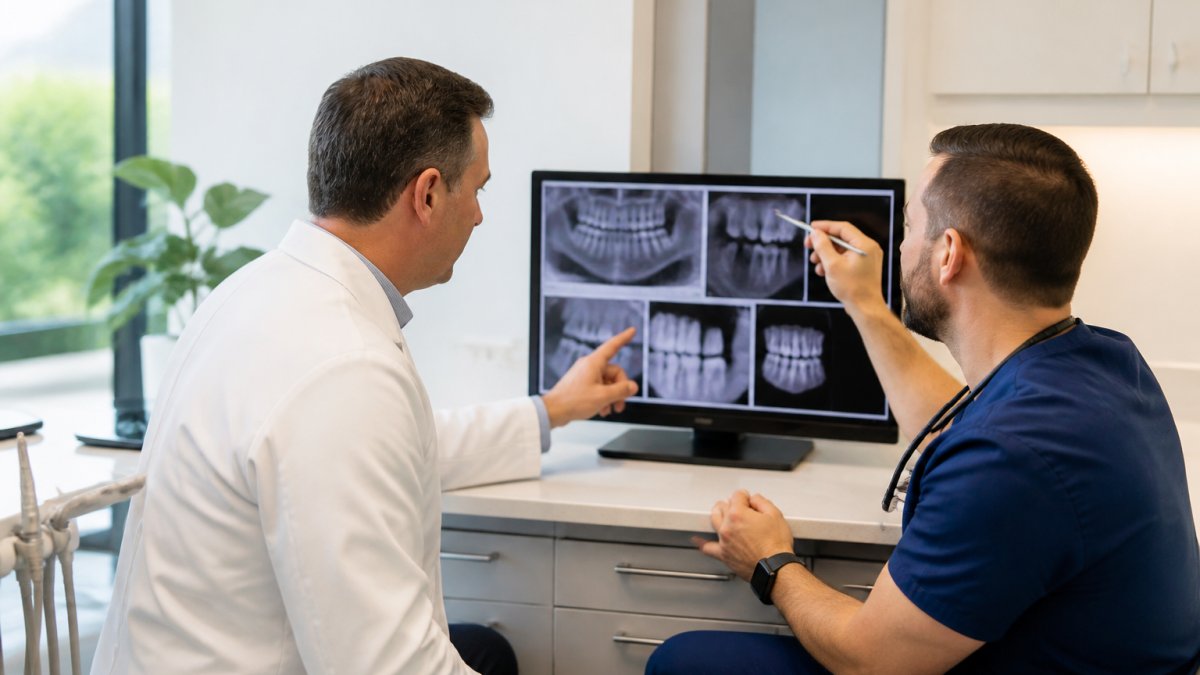
Most failed referrals fail at the handoff, not the treatment. A referral is not a piece of paper; it is a transfer of responsibility that has to be accepted, documented, and closed. The workflow below is built so that every referral has an owner at every stage and a clear end state: the general dentist knows what happened and what comes next.
- Identify the need and name the question. The general dentist confirms the case exceeds routine care and writes the specific clinical question, for example, "Is tooth #14 restorable, or does it need extraction and implant planning?" A vague reason ("needs specialist") forces the specialist to guess and often triggers a second round of records.
- Prepare the packet before the patient leaves. Assemble chart notes, relevant imaging, medical history, medications, and insurance details in one place. The checklist in the next subsection is the minimum.
- Send through a secure, trackable channel. Use a secure, trackable channel for sending referrals, and record the date sent and the receiving office's confirmation.
- Book the appointment before the patient walks out. Scheduling at the front desk, or a warm transfer to the specialist's scheduler, is the single biggest lever on referral completion. A patient who leaves with a phone number and no appointment is the most common leak.
- Confirm the patient was seen. The specialist's team can notify the referring office when the patient arrives.
- Return a written consultation report. Findings, treatment performed, recommendations, and requested follow-up go back to the general dentist in writing, not a verbal hallway summary.
- Close the loop and schedule the next step. The general dentist's team can confirm the report arrived and book any follow-up care.
Closed-Loop Referrals: Assigning Accountability
A closed-loop referral means the referring dentist confirms the patient was seen, receives a treatment report, and knows the outcome. Open loops, referrals with no confirmation and no report, are where continuity breaks down and where patients fall out of care.
A workable accountability model assigns three roles:
- Referral coordinator (front office): logs every outgoing referral with date, specialist, reason, and status; follows up on unconfirmed appointments weekly.
- Clinical lead (dentist or hygienist): reviews returned reports, decides on follow-up, and flags cases that need a phone call rather than a form.
- Specialist liaison: at the receiving office, confirms arrival and sends the report within an agreed turnaround (many practices target 3-5 business days for routine cases).
Run a weekly open-referral huddle. Pull the list of referrals older than the agreed turnaround and ask one question per patient: what is the next action, and who owns it?
Handling Urgent Referrals, Delays, and Failed Handoffs
Not every referral can follow the routine path. Build an escalation track for the exceptions:
- Urgent cases get a phone call, not a form. Suspected infection with swelling, trauma, or uncontrolled pain warrants a direct call to the specialist's office and a same-day or next-day appointment, with the call documented in the chart.
- Missed appointments: the specialist's team notifies the referring office within one business day; the referring office calls the patient to reschedule. Do not wait for the patient to reappear.
- Long waits: if the soonest appointment exceeds a clinically acceptable window, the referring dentist considers an alternative specialist or interim management rather than letting the patient wait untreated.
- Patients who cannot access specialist care: document the barrier (cost, transportation, insurance) and discuss interim options, including whether the general dentist can safely manage part of the care.
- Failed handoffs: when a report never arrives, escalate to the specialist's clinical lead by phone and log the escalation. A pattern of missing reports is a workflow problem to fix, not a one-off to absorb.
Measuring Whether the Workflow Works
You cannot improve coordination you do not measure. Four metrics cover most of the ground and can be pulled from practice-management software without new tools:
- Referral completion rate: percentage of referrals that result in a completed specialist visit.
- Time to specialist appointment: days from referral sent to visit date.
- Report turnaround: days from specialist visit to written report received.
- Follow-up completion: percentage of patients who return to the general dentist for the planned next step.
Review these monthly. A slipping completion rate usually points to scheduling at the point of referral; a slipping report turnaround points to the specialist side. Fix the specific leak rather than adding more steps.
Here is the referral workflow at a glance, from naming the clinical question to closing the loop.
| Step | What to do |
|---|---|
| 1 | Confirm case exceeds routine care; write specific clinical question |
| 2 | Prepare packet: chart notes, imaging, medical history, medications, insurance |
| 3 | Send through secure, trackable channel; record date and confirmation |
| 4 | Book the appointment before the patient walks out |
| 5 | Confirm the patient was seen by the specialist |
| 6 | Return a written consultation report to the general dentist |
| 7 | Close the loop and schedule the next step |
Where Collaboration Breaks Down: Urgent Referrals, Delays, and Failed Handoffs
The evidence for collaboration is not uniformly strong. A 2017 review of interprofessional collaboration found such strategies may only slightly improve patient functional status. That review covered health and social care broadly, not dentistry specifically, but it is a fair warning: collaboration done badly helps no one.
Watch out: the most common failure is a referral sent with no imaging and no follow-up owner. The patient waits, the specialist guesses, and the general dentist never learns the outcome.
How Interdisciplinary Care Teams Improve Patient Outcomes
An interdisciplinary care team brings dental and medical providers together around one patient. For a closer look at why these teams produce better results, see our article on the benefits of multi-specialty dentistry. The payoff shows up in outcomes, quality of life, and satisfaction, according to research on integrating dentistry into interprofessional healthcare.
Oral health is connected to the rest of the body, and medical history can be relevant to dental planning.
Requesting a Specialist Appointment at EPO Dental Specialists
Collaboration only pays off when the specialist side is easy to reach. Our multi-specialty team in Richardson includes a Board-Certified periodontist, an endodontist trained in complex root canal treatments and endodontic surgery, and a certified orthodontist. We work with your personal dentist.
If you need endodontic care, you can request an appointment with our team.
Coordinating care across providers takes effort, and the gaps are where outcomes slip. If you are managing gum disease, a stubborn root canal, or alignment work alongside your general dentist, we can work with your referring dentist.
Frequently Asked Questions
What is the difference between a general dentist and a specialist?
A general dentist handles routine exams, cleanings, fillings, and preventive care and acts as your dental home. A specialist completes additional residency training in one area, such as endodontics for root canals, periodontics for gum disease, or orthodontics for alignment. The general dentist vs specialist relationship works best as a partnership: your general dentist spots the problem and coordinates care, while the specialist handles the complex procedure and reports back. That division keeps treatment efficient and protects continuity of care.
When should a general dentist refer a patient to a dental specialist?
A dentist specialist referral usually makes sense when a case falls outside routine care: a root canal with complex anatomy, advanced periodontal disease, a tooth that needs retreatment, or orthodontic alignment. Referrals also help when a patient has diabetes, cardiovascular conditions, or other medical issues that raise treatment risk. Earlier referral tends to preserve more natural tooth structure and shortens time to specialist appointment, which supports better long-term oral health outcomes.
What information should be shared when a dentist refers a patient to a specialist?
A complete referral packet includes the reason for referral, relevant radiographs, periodontal charting, medical history, a medication consultation summary, and any prior treatment records. It should also note the patient's chief complaint and scheduling preferences. Sharing this upfront reduces duplicate imaging, supports accurate diagnosis, and lets the specialist plan treatment without delay. Patients can help by asking their general dentist to send records ahead and by keeping a list of current medications.
How does coordinated dental care help patients with complex treatment needs?
Complex dental cases often involve several providers: a periodontist for gum disease, an endodontist for a root canal, and an orthodontist for alignment. Dental care coordination means those providers share records, agree on a treatment plan, and sequence procedures in the right order. This reduces conflicting recommendations, avoids repeated visits, and improves continuity of care. Patients with multiple needs benefit most from a multi-specialty practice where the integrated care team can plan together and communicate with the referring general dentist.