
 ultimate-guide
Advanced Endodontic Technology: Benefits for Patients
Last Updated: November 5, 2026
Quick Summary
Advanced endodontic technology, such as three-dimensional imaging, dental operating microscopes and digital sensors, helps specialists see the root canal system more clearly. It does not change the goal of root canal therapy, which is to remove infected tissue and preserve the natural tooth. The benefits depend on each case and the skill of the specialist using the equipment.
- Cone-beam CT shows three-dimensional anatomy that a standard two-dimensional X-ray can hide.
- Operating microscopes provide magnification and focused light to help locate and treat fine canal structures.
- CBCT delivers more radiation than a standard X-ray, so it is ordered only when it will answer a specific question.
- Technology supports good outcomes but does not guarantee them; tooth condition and restoration also matter.
- Ask your specialist what question a scan will answer and how the result will change your treatment plan.
Table of Contents
EPO Dental Specialists treats tooth infections, cracks and damaged pulp, and our specialists use a range of imaging and instrumentation tools in that work. Modern endodontic technology is the group of imaging, magnification and instrumentation tools that help a specialist see the root canal system more clearly. It does not change the goal of root canal therapy, which is to remove infected tissue and preserve the natural tooth.
A 2025 review describes cone-beam computed tomography as enabling assessment of the three-dimensional relationship between a tooth and surrounding vital structures Clinical Benefits and Limitations of Cone-Beam Computed Tomography. A two-dimensional X-ray flattens the anatomy, while a three-dimensional scan lets the clinician see where a canal runs, where a lesion sits and how a tooth relates to the nerves and sinuses nearby.
The category covers several connected tools:
- Three-dimensional imaging, such as cone-beam computed tomography (CBCT)
- Dental operating microscopes that provide magnification and illumination
- Digital imaging and sensors that replace film radiographs
- Modern instruments, including ultrasonic tips and rotary files, used to clean and shape canals
Artificial intelligence is also being explored in this space. A 2024 scoping review reports that AI models have shown potential benefits in analyzing root canal anatomy and detecting periapical lesions at early stages Artificial Intelligence in Endodontics: A Scoping Review. That work is still developing, and it supports diagnosis rather than replacing the clinician's judgment.
Technology is a tool, not a guarantee. The benefits depend on the case, the tooth and the skill of the person using the equipment. Our practice uses these tools to help our specialists plan and carry out treatment.
CBCT Imaging for Root Canals: Seeing the Tooth in Three Dimensions
Cone-beam computed tomography, usually called CBCT, produces a three-dimensional picture of the teeth, jaw and surrounding bone. For root canal care, its main value is showing anatomy that a standard periapical X-ray can hide, such as additional canals, the full extent of a lesion or a root fracture running in an unexpected direction.
A 2024 study reports that applying American Association of Endodontists and American Academy of Oral and Maxillofacial Radiology case-selection guidelines for CBCT validated those guidelines and positively affected endodontic decision-making Applying the American Association of Endodontists and American Academy of Oral and Maxillofacial Radiology Guidelines for Cone-Beam Computed Tomography. In other words, the scan is most useful when it is ordered for the right reasons.
That caution matters. CBCT delivers more radiation than a standard X-ray, so it is not taken routinely for every tooth. A 2025 review explicitly addresses both the benefits and the limitations of the technique, which is why clinicians weigh each scan against the patient's specific needs Clinical Benefits and Limitations of Cone-Beam Computed Tomography.
If a specialist recommends a 3D scan, ask what question it will answer and how the result will change the plan.
The Role of Dental Operating Microscopes in Treatment Precision
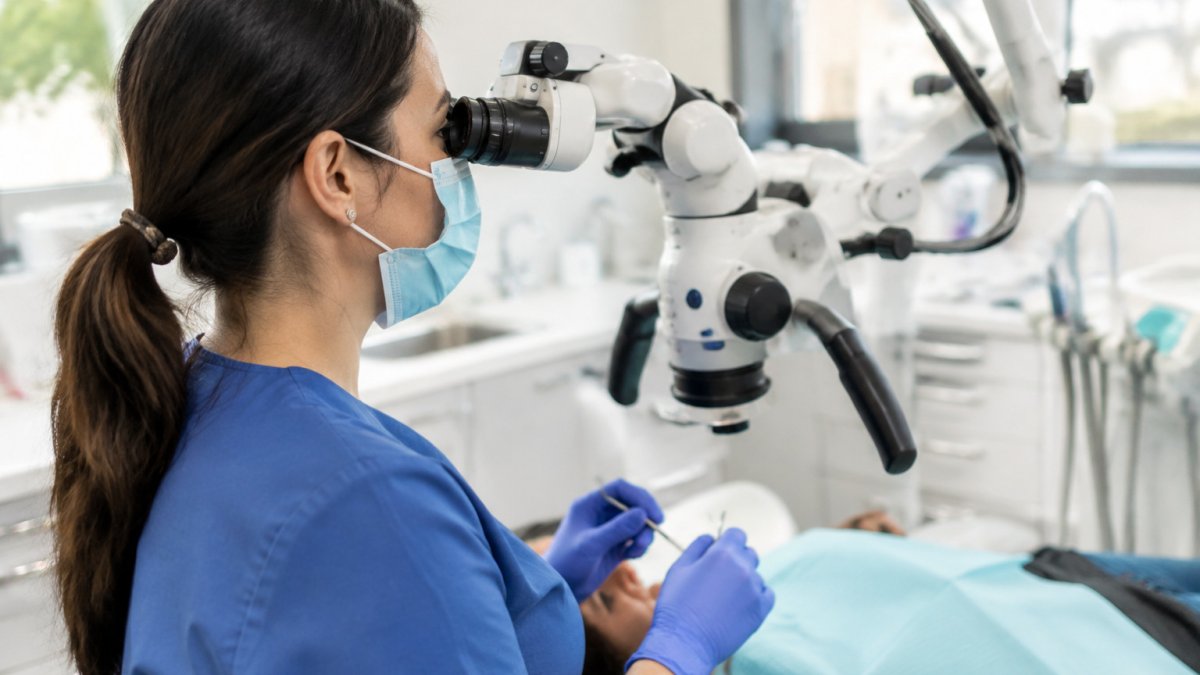
A dental operating microscope provides magnification and focused light so the clinician can see fine structures inside the tooth. Root canals are narrow, curved and often hidden, so magnification helps the specialist locate canal openings, check that instruments are seated properly and remove tissue with more control.
The benefit is best understood as visibility. Better visualization can support more careful cleaning and shaping of the canal system. The microscope does not perform the treatment on its own; it lets the specialist see what their hands are doing.
Digital Imaging, Instrumentation and Patient Comfort
Digital imaging replaces film with electronic sensors, producing images that appear on screen quickly. Modern instrumentation, including ultrasonic tips and rotary files, helps the team clean and shape the canal efficiently.
Patient education sources describe digital imaging, 3D printing and advanced instrumentation as tools that can make root canal procedures more comfortable and efficient What Is Endodontic Technology?. Comfort is also shaped by the environment and the clinician's communication. If you are anxious about treatment, tell your specialist before the appointment begins so they can plan breaks, explain each step and check that you are comfortable.
How Technology Relates to the Success Rate of Root Canal Treatment
Many patients want to know whether newer equipment improves the odds that a root canal will last. The honest answer is that technology supports good outcomes but does not guarantee them. Success depends on factors such as the tooth's condition before treatment, the complexity of its canals, the quality of the restoration placed afterward and how well the patient follows care instructions.
Advanced imaging and magnification can help a specialist see anatomy that might otherwise be harder to assess. Ask your specialist to explain the expected outcome for your specific tooth.
Cost-Benefit Considerations and Limitations of New Technology
Advanced technology often adds to the cost and time of care, so it is reasonable to ask whether a given tool is needed for your case. Prices vary by practice, tooth and treatment plan, so please contact EPO Dental Specialists for current pricing or a personalized estimate.
The limitations are real. CBCT involves more radiation than a standard X-ray, equipment does not remove the need for clinical skill, and some newer tools are still being studied. A 2025 review's explicit attention to limitations is a reminder that no technique should be presented as universally beneficial Clinical Benefits and Limitations of Cone-Beam Computed Tomography. A specialist can explain what each tool adds and when a simpler approach may be enough.
Booking a Consultation to Decide Whether Advanced Technology Fits Your Care
The best way to decide whether advanced technology fits your care is a consultation. At EPO Dental Specialists, you can discuss your care and learn how advanced equipment might be used for your tooth. Our specialists work collaboratively with your personal dentist. If you are preparing for a procedure, you can review the surgical instructions for Richardson residents before your visit.
Before you book, it helps to prepare a few questions: What is wrong with my tooth? Would advanced imaging change the plan? What will treatment cost, and what does the restoration involve? If you are unsure where to start, a step-by-step guide to book an endodontic consultation explains what to expect, and our page on our dental technology in Richardson describes the practice's equipment. To understand what comes after treatment, see root canal treatment in Richardson.
Frequently Asked Questions
Is root canal treatment painful with modern technology?
Modern technology does not make root canal treatment pain-free in every case, and no provider can guarantee that. Digital imaging and magnification can help a specialist see the canals more clearly. Local anesthesia is still the main way discomfort is managed during treatment, and many patients report soreness for a few days afterward. Discuss your anxiety and pain concerns with the specialist before treatment so a plan can be made for your comfort.
Does CBCT imaging expose patients to more radiation?
Cone-beam computed tomography produces a three-dimensional image and delivers a higher radiation dose than a standard periapical X-ray. Dentists generally use it when two-dimensional images cannot answer a clinical question, such as a complex root canal anatomy or suspected fracture. Professional guidelines from the American Association of Endodontists and the American Academy of Oral and Maxillofacial Radiology recommend that CBCT be used for specific clinical reasons. Ask your provider why CBCT is recommended for your situation.
Is it better to have a root canal done by an endodontist?
An endodontist is a dentist who has completed advanced training in root canal anatomy, diagnosis and treatment, including retreatment and endodontic surgery. For complex cases, such as curved or previously treated canals, specialty training and magnification equipment can matter. General dentists also perform many routine root canals well. Your general dentist can help you decide whether a referral is appropriate for your tooth.
What is the success rate of a root canal?
Published success rates vary with the tooth, the complexity of the case, and how success is defined. Treatment outcomes depend on factors including the condition of the tooth before treatment, the quality of the restoration afterward, and the patient's oral hygiene. Your specialist can explain the expected outcome for your specific tooth and what you can do to protect it after treatment.